
You’ve probably noticed that Microsoft has been adding an almost constant stream of new artificial intelligence (AI) features to Windows 11. The most prominent is Copilot, Microsoft’s AI-powered assistant – which even has its own dedicated key on modern PC and laptop keyboards. But there are plenty of other AI tools that can help you be more productive and creative, if you know where to look.
Not that they’re all necessarily worth using, of course. Microsoft’s passion for adding AI into everything hasn’t been met with the same level of interest from Windows 11 users, and while there are certainly some new game-changing AI features, there are also ones that aren’t that useful at all.
How do you know which is which? Don’t worry – I’ve collected what I think are the five best AI features you should be using right now in Windows 11.
1. Windows Studio Effects

Making video calls to friends, family and work colleagues remains a big part of our lives, which is why the AI-powered Windows Studio Effects feature is likely to be one of the most useful tools Microsoft has recently added to Windows 11.
Windows Studio Effects is a suite of AI tools that have been designed to help make your video calls look as good as possible, even if you’re using your laptop’s basic built-in webcam.
Automatic framing cleverly crops the video so that you’re in the center of the video and in focus. It can track you even if you move and adjust the footage so you remain in shot.
Portrait light is a great tool for brightening up your face in video calls, without the need of an external ring light, even in environments where lighting isn’t great.
Eye contact adjusts your eyes so that it looks like you’re looking directly at the person you’re speaking to, rather than looking at the webcam (which is often at the top of the screen, leading to video calls where it seems as if no one is actually looking at each other). When this tool was first shown off in Windows 11 the effect was a bit creepy, but it’s been improved, and if you have a Snapdragon Copilot + PCs device, you can use the Teleprompter option for an even more natural effect.
Windows Studio Effects can also blur the background of your footage, and you can apply a variety of creative filters to make your video calls more fun.
Finally, Voice focus uses AI to isolate the sound of your voice and minimize background noise, so you’re easier to hear.
To access Windows Studio Effects, open the small menu next to the time and date on the Taskbar and select Studio Effects.
2. Live Captions and Translation

One of the most exciting things about AI is its potential to make our tech more accessible, which is why Live Captions is one of Windows 11’s must-have features.
Using AI, it can automatically turn speech from audio or video sources into text and display it on your screen. Not only does this help people who have hearing issues (such as myself) enjoy movies or shows that don’t include subtitles, but it can also be used for video calls.
You can also change the language that Live Captions displays, which means it makes for an excellent live translation tool as well; it can display the captions in your chosen language, even if it differs from the original language being used.
To turn on this feature, press the Windows key + Ctrl + L on your keyboard. You can also turn this feature on in the Accessibility section of Windows 11’s Settings app.
3. Generative Erase

To Microsoft’s credit, the AI features it’s adding to Windows 11 don’t just focus on complex and premium apps – it’s also been adding AI to its more basic apps, such as Photos, which has made a big difference in how useful these built-in apps are.
Photos is Windows 11’s default app for viewing and editing photos you’ve imported from your camera or smartphone, and it now features Generative Erase. This handy tool uses AI to quickly and easily remove objects and people from photos by blending the background so you can paint over what you want to remove, making the subject literally disappear.
It does a really good job, and means the free Photos app now offers a feature you’d usually expect from paid-for apps such as Photoshop.
You can use Generative Erase to tidy up your photos (such as removing background people from a photo of your family), and it can also be used to remove blemishes or artefacts from your photos as well.
4. Text recognition in screenshots

Windows 11’s Snipping Tool is another great example of a basic app getting AI smarts, as it can now recognise text in screenshots. This can be incredibly useful for taking information out of a screenshot and putting it in another app.
For example, say you’re on a website that shows photos of historical texts and you want to quote from one of them. You can now take a screenshot using the Snipping Tool (just press Print Screen on your keyboard), and the app will use AI to read and understand the text in the photo (as long as it’s legible). You can then select the text you want to quote, copy it, then paste it into a word processing app. You can access this feature in Snipping Tool and by clicking the Text actions button.
5. AI actions in File Explorer
File Explorer (once known as Windows Explorer) has been an essential part of Windows since its introduction in Windows 95, 30 years ago, and Microsoft is continuing to add AI-powered features to keep it feeling modern.
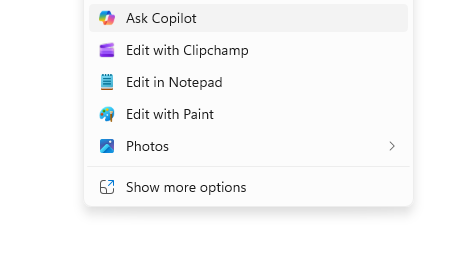
With the latest major Windows 11 update, 25H2, AI actions have been added. When using File Explorer to find a file, you can right-click and in the new AI actions section of the menu you’ll get quick access to some handy AI-powered features.
So, if you right-click on an image, you can select to Blur background with Photos, Erase object with Photos, Remove background with Paint or perform a visual search with Bing, Microsoft’s search engine. These can be quick shortcuts that help get you started when editing a file.
Copilot is now also integrated into File Explorer – right-click on a file and select Ask Copilot and you’ll be able to ask the AI assistant to perform actions with the selected file. For example, if you have a large Word document, you can ask Copilot to summarize the contents of the document, giving you a quick and easy-to-read bullet point list of the key parts.
Natural language search is also rolling out to File Explorer. In the past, you could use File Explorer to search for specific files by typing in the file name in the search box. With natural language search you don’t have to be precise. Instead of having to know the exact name of a file, you can describe it – for example asking it to search for a “budget spreadsheet you created two weeks ago.” This makes finding files a lot easier and more natural-feeling.
Some of these features require a laptop with an NPU, so if you’re on an older machine, you might not have access to them, so it’s worth checking out our best laptops buying guide if you’re tempted to upgrade.
Source: techradar
Leave a Reply