By Amanda Caswell
If you’ve ever switched from typing to talking to ChatGPT and thought, “Wait… why does this response seem so different?” — you’re not imagining it.
I’ve used ChatGPT for years to brainstorm, outline stories, analyze AI tools and think through complicated ideas. When I use it as a chatbot, I notice that the response are sharp, informative and helpful with clear bullet points. The chatbot anticipates what I need and even goes deep when necessary.
But when I tap the little waveform icon and switch to ChatGPT Voice, I get something else entirely different — friendlier, warmer, breezier… and often less helpful. At first, I assumed it was in my head. So I ran a series of side-by-side tests, and I’m now convinced: ChatGPT Voice is not the same “person” as text ChatGPT. Not in tone, not in depth and not in usefulness. Here’s what I found.
My side-by-side tests
Test 1: A complex explanation
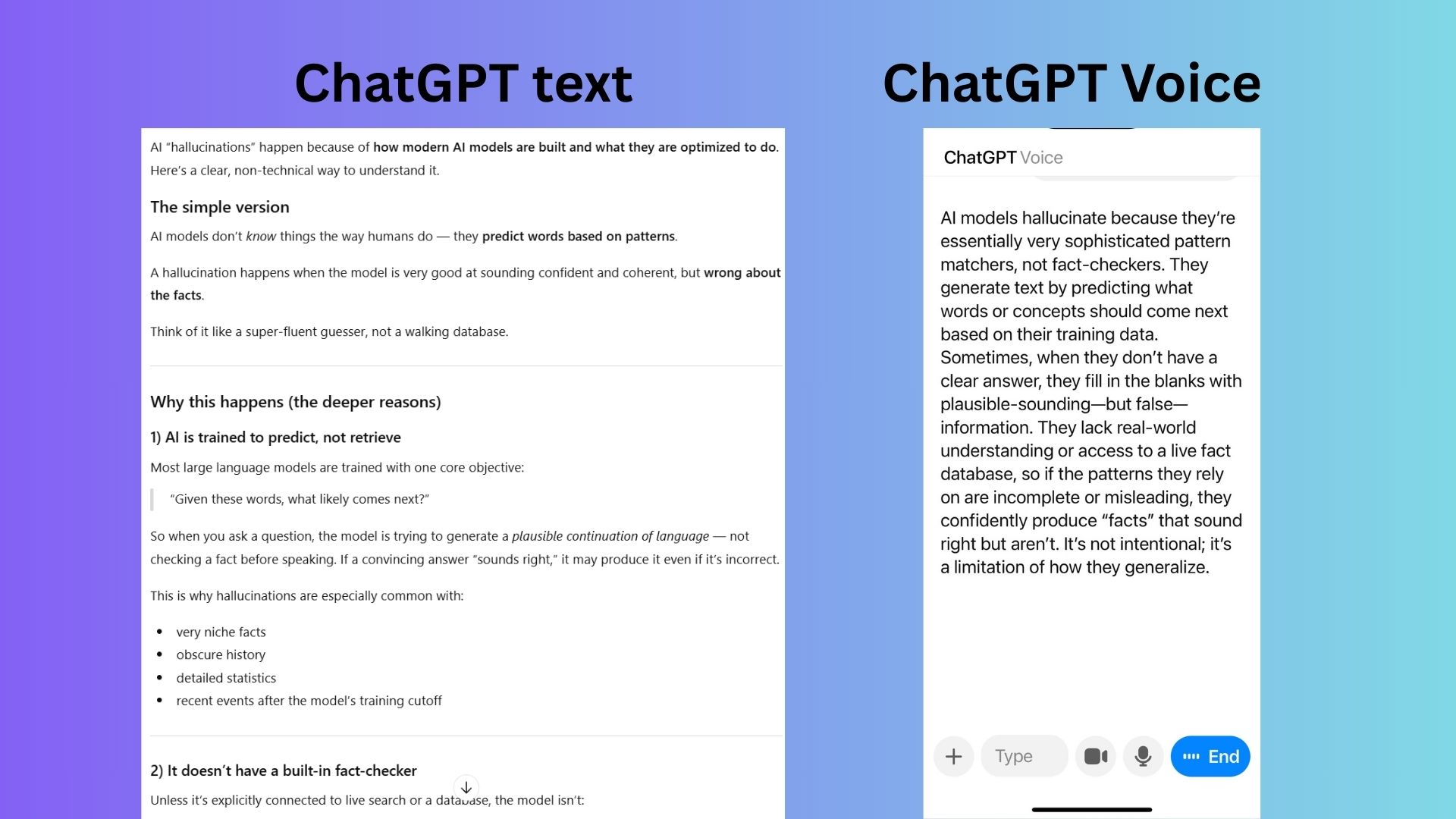
Prompt: “Explain why AI models sometimes hallucinate.”
While both responses accurately explain why AI hallucinations occur, they differ significantly in structure and depth. The response from the chatbot was a comprehensive look at why models hallucinate but the response from ChatGPT Voice was more of a quick elevator pitch. The response from the chatbot was scannable, yet thorough and complete with specific sub-points.
The response from ChatGPT Voice was a single, dense paragraph. While clear, it requires more mental effort to parse the individual reasons why hallucinations happen because the ideas are bundled together. In other words, ChatGPT Voice left me without a strategy for how to handle the problem. That would have required me to continue the conversation.
Test 2: A practical task
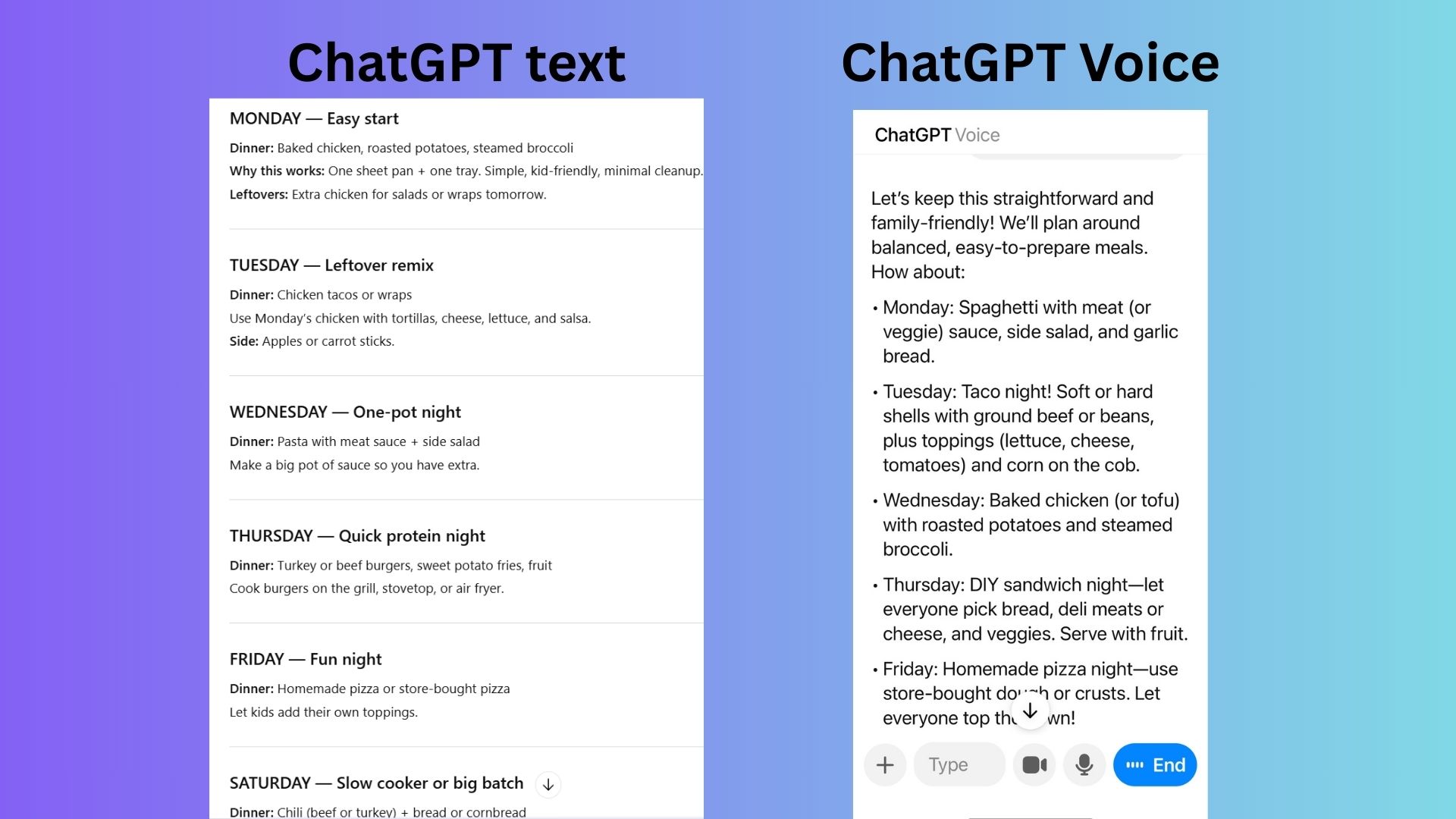
Prompt: “Help me plan a simple weekly meal plan for a family of five.”
With this request, ChatGPT as a chatbot delivered a comprehensive strategy for meal planning with an emphasis on efficiency through “leftover mixes” integrated as grocery lists and even suggestions for breakfast and lunch. The response from ChatGPT Voice acted more like a quick inspiration list, rather than the functional, low-stress guide from the chatbot. In this case, ChatGPT Voice felt surface level while the text response delivered a clear plan. I thought it was interesting how wildly different the menu options were from each version of ChatGPT as well.
Test 3: Advice for a tricky situation
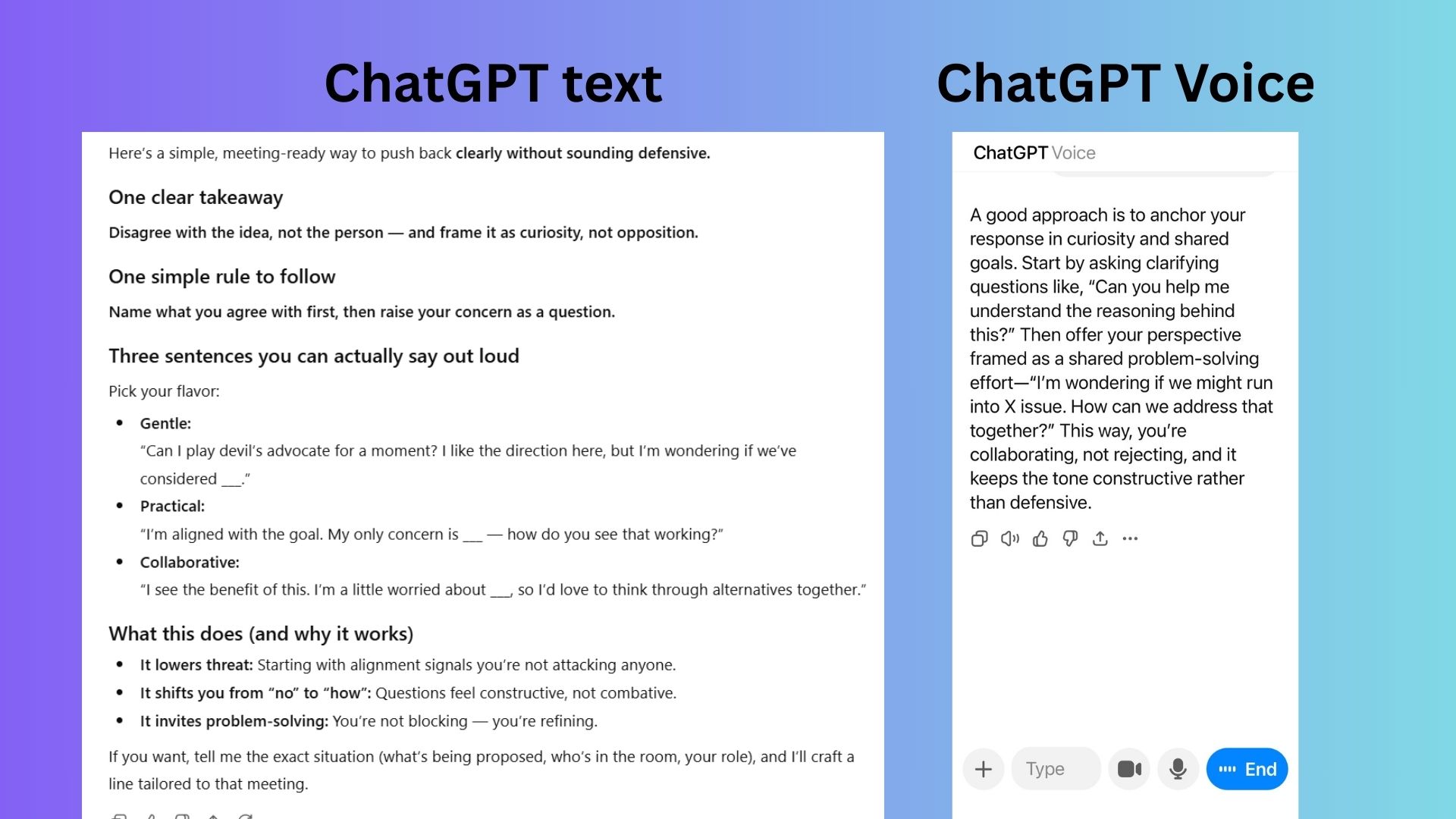
Prompt: “How should I push back in a meeting without sounding defensive?”
For this situation, ChatGPT offered me a a tactical toolkit designed for immediate application when prompted via text. However, when I used ChatGPT Voice, the response was more of a brief conceptual summary. The chatbot broke the advice down into a structured hierarchy — offering specific psychological “rules,” categorized templates for different social tones (Gentle, Practical, Collaborative), and a clear explanation of the underlying logic. In contrast, ChatGPT Voice delivered the same core philosophy of “curiosity and shared goals” in one single paragraph, providing a general narrative rather than a step-by-step guide.
Once again, ChatGPT Voice simply told me what to do, which ChatGPT the chatbot told me how to do it, which is arguably more helpful.
Why this happens

The two modes are optimized for different jobs. It’s almost like ChatGPT as a chatbot is in work mode while ChatGPT Voice is in social mode. When you type, ChatGPT is optimized to think carefully, organize information and give structured answers with examples and nuance. When you speak, the priorities shift: sound natural, keep the conversation flowing, avoid long monologues, feel warm and human. Same model, completely different personality.
Another important thing to consider is that ChatGPT Voice assumes you’ll interrupt. In the chatbox, ChatGPT assumes you want a complete answer in one go. In Voice, it assumes you might cut in, change your mind or redirect mid-thought — so it often gives a shorter first answer on purpose, waiting for you to steer. If you don’t, it can feel underwhelming.
Spoken explanations are simplified by design. We tolerate complexity on the page far more than we do in speech — imagine listening to someone read a dense essay out loud versus skimming it yourself. Voice leans toward spoken clarity: fewer details, fewer examples, fewer caveats, more high-level explanations. Great for casual chats; not great for deep thinking.
Where ChatGPT Voice shines

Although ChatGPT text seemed like the better option in my examples above, in my testing, Voice outperformed text in a few situations:
- Talking through emotions or social dilemmas
- Practicing conversations or a second language
- Explaining something simply to a child
- Hands-free help while cooking, walking or driving
- Casual brainstorming out loud
If your goal is connection or convenience, Voice is genuinely the better tool. But Voice usually falls short when you really need a thinking partner. I prefer using ChatGPT as a chatbot for research, analysis, planning or anything where I need bullet points and structure. In these cases, Voice can feel like a significant downgrade. This is why most power users still prefer text.
How to make Voice behave more like text
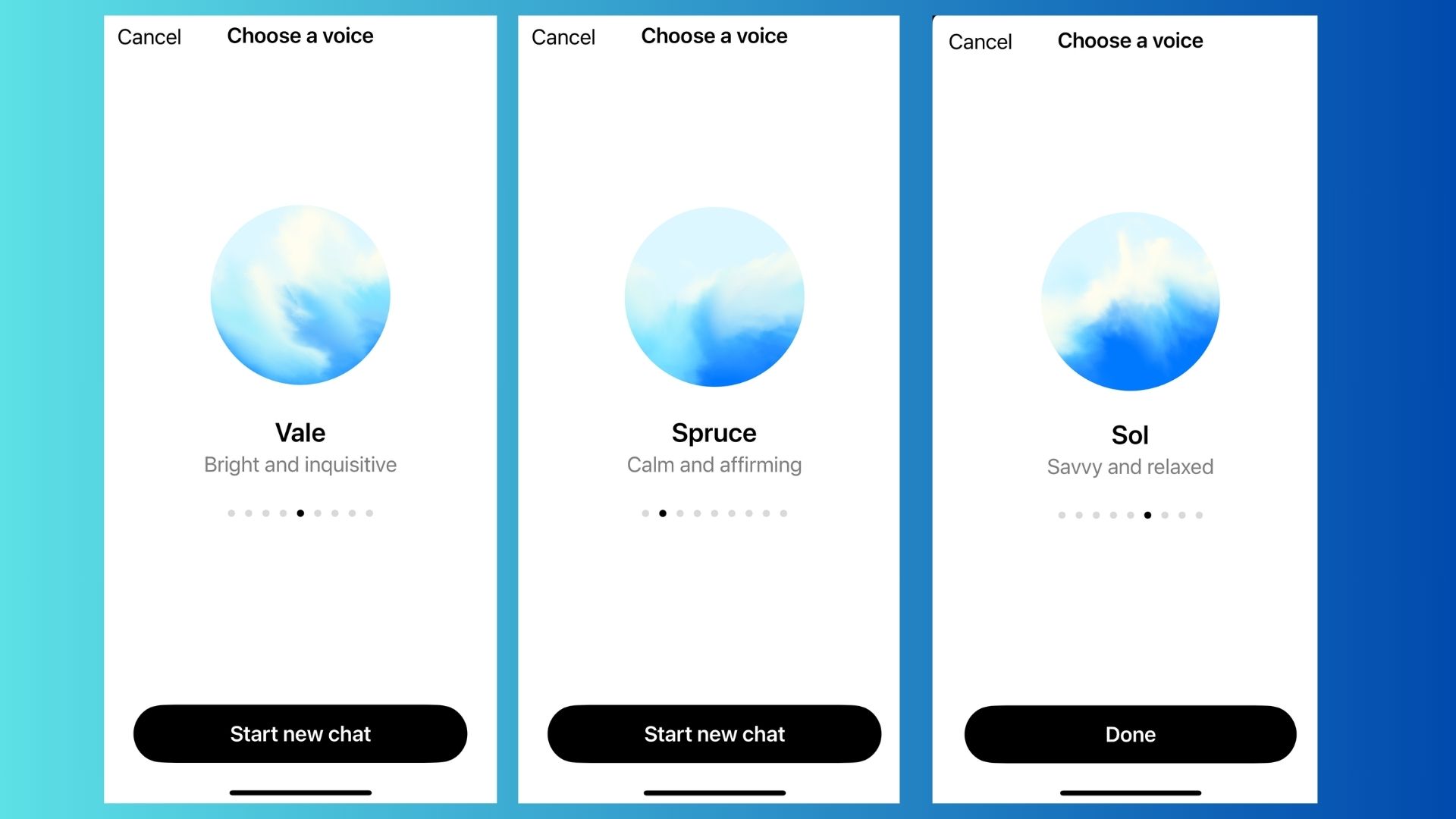
To make ChatGPT Voice give more thorough and less surface-y responses, you’re going to need to be far more explicit about what you want.
Every time I used one of these, I got longer, clearer, more useful responses. These are the phrases that consistently worked for me.
- “Explain this like you’re writing it, not speaking it.”
- “Give me a structured, detailed answer.”
- “Don’t simplify — go deep.”
- “Talk to me like I’m reading an article.”
Bottom line
You’re not imagining it. ChatGPT Voice isn’t simply ChatGPT read aloud — it feels like a genuinely different personality, optimized for natural back-and-forth rather than deep analysis.
Voice is designed to keep a conversation moving: warmer, smoother and more human in tone, even if that sometimes means being lighter on detail. Text, on the other hand, is where ChatGPT slows down, thinks more carefully and gives you sharper, more precise answers.
So if you want connection and flow, go with Voice. If you want depth and rigor, stick to text.
Source: Tom’s Guide
Leave a Reply